
Featured OEM Smart Eyewear Hardware Solutions
Explore our state-of-the-art wearable AI glasses manufactured for cross-border brand owners, vision rehabilitation agencies, and global importers. Each model supports custom firmware, private labeling, and regional SDK localization.
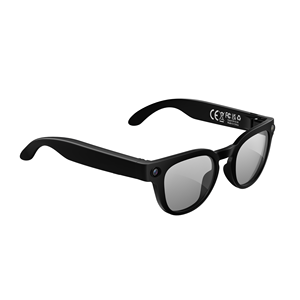
New Vision MT3 Smart AI Glasses With 8MP Camera HD Touch Button AI Translation Voice Assistant Fast Charging Sport BT Sunglasses
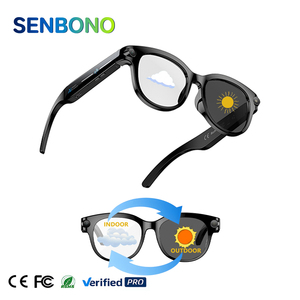
SENBONO M89 Smart Polarized Glasses Dual Camera 2MP IPX5 Waterproof Photochromic Lenses HD Video Recording 290mAh Battery AI

Professional AI Smart Translation Glasses 164+ Languages Real-Time Open-Ear Audio Anti-Blue Light Half-Rim Business Glasses
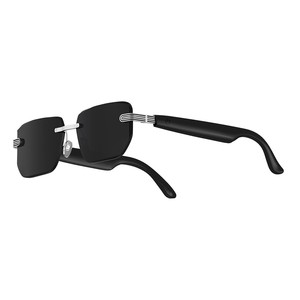
AI Smart Glasses Real-time Translation 145 Languages Photochromic Lenses Audio Video Calls Meeting Recording Voice Assistant
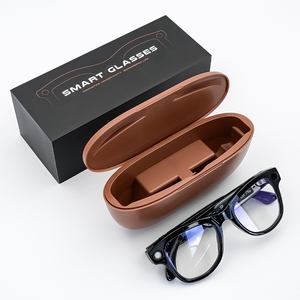
Newest SANVNET GS5 MAX 2026 AI Smart Glasses with Charging Case 8MP 4K Camera WIFI Smart Video Sunglasses Glasses Translation
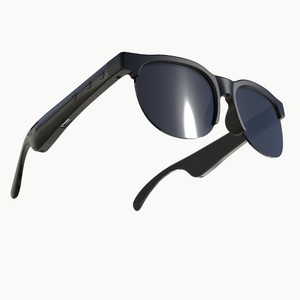
New Smart Glasses: Bluetooth Glasses with Open-Ear Bluetooth Calling for Outdoor Sports Cross-Border New Arrival
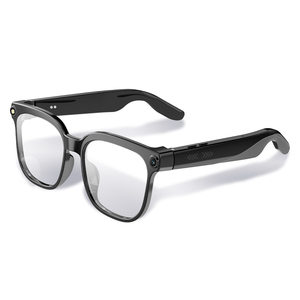
AI Smart Glasses with HD Camera Real-Time Translation Touch Operation Intelligent Recognition 16MB Camera Video Recording
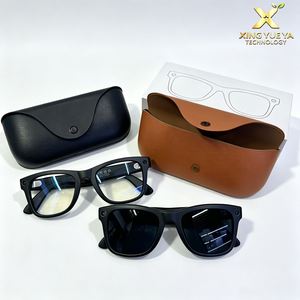
MT5-Ultra AI Smart Glasses Real-Time Trans 8MP Camera 1080P AI Translation Music Wi-Fi transmission with Charging case
Evaluating the Top 10 Wearable Vision Factories & OEM/ODM Supply Chains
The global smart eyewear market is undergoing a paradigm shift from basic Bluetooth frame audio to integrated Edge-AI visual processing engines. For B2B procurement directors, brand owners, and medical device distributors, selecting the right manufacturing partner requires rigorous technical evaluation across six key engineering capabilities.
1. Optical-Engine & SMT Integration
Top-tier factories feature Class 100,000 dust-free cleanrooms designed specifically for micro-camera lens alignment, Waveguide coupling, and double-sided Surface Mount Technology (SMT) on ultra-narrow flexible PCBs (Rigid-Flex PCB) that fit into 3.5mm frame temples.
2. On-Device AI Silicon Architecture
Leading manufacturers bypass high-latency cloud pipelines by integrating NPU-accelerated SoC chipsets (such as Qualcomm Snapdragon AR1 Gen 2 or custom RISC-V Neural Processors) capable of running quantized visual transformer models offline at sub-watt power consumption.
3. Ergonomic Weight Distribution
Industrial design benchmarks mandate a maximum frame weight of < 50 grams. Premier factories utilize magnesium-titanium alloys and split-battery architectures in both temple tips to maintain a 50:50 center-of-gravity balance over the nasal bridge.
| Factory Tier & Region | Primary OEM Capability | Optical / Camera Stack | Compliance & Certifications | Ideal Procurement Scope |
|---|---|---|---|---|
| Tier 1: Shenzhen Tech Hub (e.g., Sprhava / Electro-Optics Plant) | Edge-AI Smart Glasses, Real-time Speech, Assistive Tech | 8MP 4K HDR Camera, Low-light Adaptive Exposure | ISO 9001, ISO 13485, CE, FCC, RoHS, FDA Class I | Turnkey ODM, Medical Assistive Wearables, Cross-Border Brands |
| Tier 1: Dongguan Precision Manufacturing | TR90 Memory Frames, IPX5/7 Waterproof Coating | Dual 2MP Micro Sensor Array, Photochromic Lenses | ISO 9001, IPX5/IPX7 Lab Validation | Outdoor Sports Eyewear, Active Lifestyle Consumer Electronics |
| Tier 2: Taiwan Optical Parks | Micro-OLED Integration, Diffractive Waveguide Optics | AR Monocular Engine, Micro-LCOS Projection | ISO 9001, CE Medical Compliance | Enterprise AR HUD Systems, Industrial Inspection Glasses |
| Tier 2: European Precision Assembly | Custom Ophthalmic Prescription Fitting & Luxury Finishing | High-index Anti-blue light, Clip-on Magnetic System | CE Eyewear Safety Standards, Medical Device Directive | High-End Prescription Retailers, European Assistive Clinics |
Future Sourcing Trends in Wearable Vision Manufacturing (2026–2030)
The shift toward multimodal Large Language Models (LLMs) and context-aware computer vision is redefining buyer specifications. Strategic procurement leaders are prioritizing four macroeconomic and technical vectors when contracting factory production lines:
Multi-modal On-Device AI Models
Future smart glasses will not merely capture photo frames; they will execute localized vision-language models (VLM) directly on frame processors. Procurement teams must source hardware platforms featuring dedicated Neural Processing Units (NPUs) capable of offline object detection, sub-second text-to-speech, and spatial hazard calculation without mobile network dependencies.
Advanced Thermal & Battery Architectures
Continuous video streaming and AI inference generate thermal dissipation challenges within localized frame plastic. Sourcing trends prioritize dual-cell silicon-anode battery configurations embedded in rear temples, combined with graphite conduction layers that keep surface temperatures under 38°C during prolonged camera usage.
Open-Ear Acoustic Directionality
Traditional ear-canal blocking audio is unacceptable for urban safety, particularly in low-vision assistive technology. Modern factories are integrating reverse-phase acoustic ducting that directs high-fidelity sound waves straight into the wearer's ear canal while reducing outward sound leakage by over 85% in quiet environments.
Prescription Lens Modular Platformization
To eliminate inventory complexity, factory contract platforms are adopting modular magnetic chassis. A single core electronic frame can now attach to progressive ophthalmic lenses, polarized sun-lenses, or photochromic filters, reducing stock-keeping unit (SKU) overhead for global distributors by up to 60%.
Enterprise OEM/ODM Manufacturing Capabilities
As a pioneer in wearable computer vision and accessibility tech manufacturing, our facilities bridge the gap between complex software algorithms and lightweight ergonomic eyewear production. We empower international clients with full vertical manufacturing capabilities.
Full-Stack Firmware & SDK Customization
We supply open Android/Linux-based firmware SDKs, allowing enterprise clients to inject proprietary speech models, brand UI audio prompts, and customized cloud API endpoints into our factory-standard chipsets.
Medical-Grade ISO 13485 Cleanroom Production
Our visual assistive smart glasses undergo dust-free cleanroom assembly, complete automated optical inspection (AOI), and rigorous drop/sweat/waterproof IPX5 endurance testing to meet strict international quality frameworks.
Global Compliance & Turnkey Logistics
All hardware produced carries pre-certified CE, FCC, RoHS, UN38.3 battery shipping safety docs, and FDA Class I documentation, drastically shortening the time-to-market for importers across North America, Europe, and Asia-Pacific.
Ready to discuss custom OEM volume production, firmware integration, or wholesale distribution?
Frequently Asked Questions for Sourcing Directors & Importers
Find direct technical and commercial answers regarding minimum order quantities, customization scope, firmware support, and factory compliance.
Scale Your Wearable Vision Line With Direct Factory Engineering
Whether you are an established eyewear distributor, an AI startup expanding into hardware, or a low-vision rehabilitation procurement agency, our engineering team provides turnkey support from prototype evaluation to mass production.